
Beate van Loo-Born Advisory

Forthcoming book

The Liquid Organisation.

Work, Governance, and Design in a Spiked World

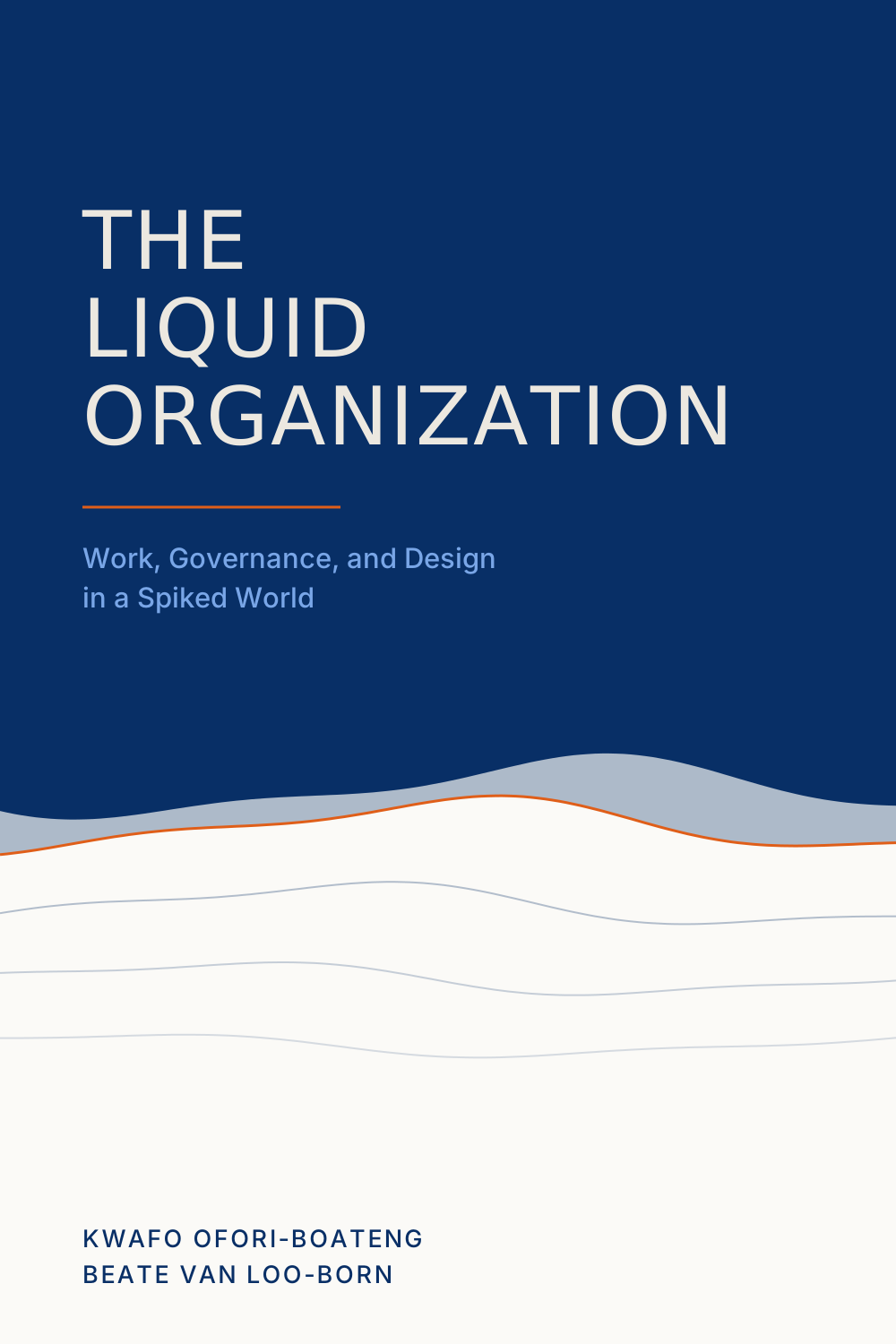
Cover of The Liquid Organisation: Work, Governance, and Design in a Spiked World, by Kwafo Ofori-Boateng and Beate van Loo-Born.

Most books on the future of work assume the instability is temporary. This one argues it is the new baseline, and that organisations designed for stability are now structurally exposed.

Publication: October 2026

Tell me when it is out

One message when the book is available. No newsletter, no sequence.

Argument

The future of work is not a technology story. It is a design problem.

Organisations are being asked to operate in a spiked world: faster, less predictable, more synthetic, more distributed, more exposed.

The old model assumed relative stability. The liquid organisation is designed for movement without losing judgment, trust, or accountability.

Thesis

Adapt or be selected out. But never at the cost of the core.

Organisations, like organisms, survive by evolving. The environment does not negotiate. What worked in the last conditions is not what survives the next ones, and structures that cannot change are selected out, slowly enough that the leadership rarely sees it happening.

But evolution is not dissolution. Every species that endures carries a core it never trades away, and so does every organisation: the product, the purpose and the mission that made it viable in the first place. Lose that in the name of adaptation and there is nothing left to adapt.

The point is not to make organisations fluid for its own sake. It is to make them capable of evolving without losing the core, the heart that guaranteed survival in the first place.

Structure

Two movements.

Part I

The Structural Environment

Automation, complexity, distributed work, geopolitics and speed. The external conditions that have made older organisational designs too rigid for the world they now face.

Part II

The Human Operating System

Judgment, safety, energy, ethics and talent mobility. The human capabilities required when machines accelerate output but consequence remains human.

Liquidity principles

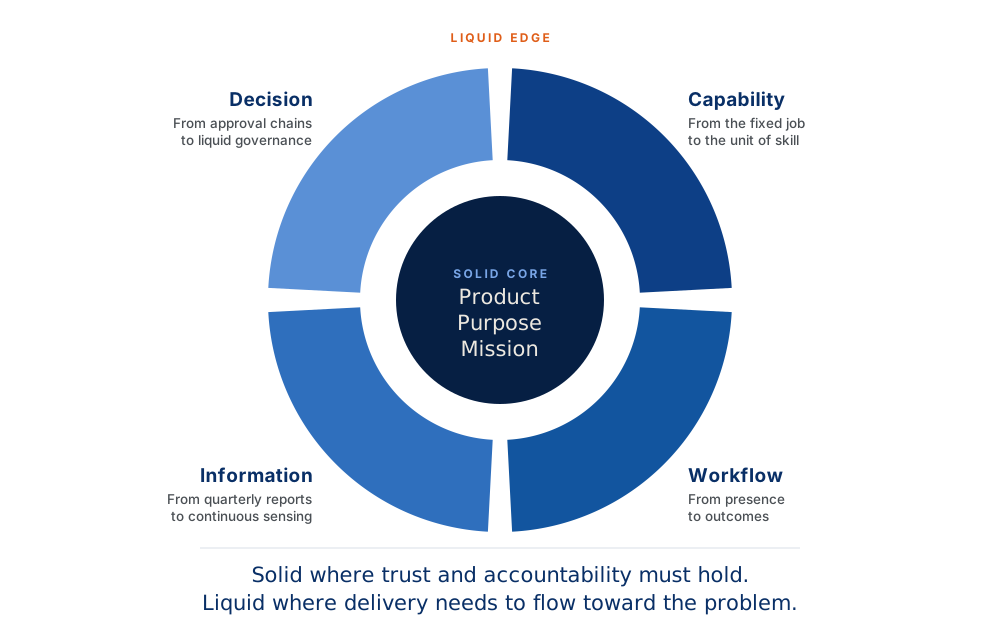
Four domains of organisational liquidity.

Diagram: a solid core of product, purpose and mission, surrounded by four liquid segments. Capability, Workflow, Information and Decision, each with the shift it describes.

Working architecture

The book moves from external pressure to internal capability.

Part I

  1. 01 The Ghost in the Machine AI, automation, and invisible work
  2. 02 Navigating the Storm Complexity, uncertainty, and decision load
  3. 03 The Dissolved Office Distributed work and the end of ambient alignment
  4. 04 Borders and Walls Geopolitics, infrastructure, and constraint
  5. 05 Need for Speed The crisis of structure

Part II

  1. 06 The Irreplaceable Core Human value when knowledge is abundant
  2. 07 The Safety to Fail Trust, silence, and organisational learning
  3. 08 Running on Empty Energy, resilience, and executive load
  4. 09 The Moral Compass Ethics, governance, and AI consequence
  5. 10 Talent in Motion Skills, mobility, and the liquid workforce

About the authors

A book on liquid organisations needs operating-model discipline and financial-system judgment.

Between us the argument covers transformation, governance, AI and work design on one side, and finance, capital discipline and sustainability on the other. That matters, because the book is not only about how organisations work. It is about how they fund, govern and sustain adaptation when the environment stops rewarding structures built for stability.

Portrait of Beate van Loo-Born.

Beate van Loo-Born

CFO and COO · Founder, BvLB Advisory · Zürich

Group CFO of Physik Instrumente until founding the Advisory, with fifteen years at UBS across Zürich, Melbourne and Singapore before that, and COO roles at SIX Group and Climate Arc. Master's degrees from Cambridge and the Sorbonne, doctoral research at Antwerp on performance in dysfunctional ecosystems.

Brings to the book: capital discipline, governance, sustainability, and the practical economics of organisational adaptation.

More about Beate

Portrait of Kwafo Ofori-Boateng.

Kwafo Ofori-Boateng

Independent executive · Board advisor · Charlotte and Melbourne

Works at the intersection of transformation, operating model, governance and AI. Previously VP and Senior Partner at IBM, VP Technology Strategy at TIAA and VP Governance at PNC and BNY Mellon. Board member at StrandSense AI, GAICD, MBA from the University of Pittsburgh.

Brings to the book: operating model design, decision rights, post-merger execution, and AI governance that reaches the P&L.

More about Kwafo

Five ways to work with it

From reading the book to rebuilding the operating model.

Enter wherever the case is already made. Nothing is wasted if you move up later, because every level reads your organisation through the same ten dimensions.

01

The Book

Read and reflect

The full argument in one volume, with the scenes, mechanisms and target states your leaders can recognise in their own organisation.

What you get

  • Ten chapters, each mapping one operating reality to a named mechanism
  • Reading guide and discussion prompts for leadership teams
  • Optional keynote or author conversation

What it asks of you. Reading time. Nothing to organise.

02

Book plus Training

Build shared language

The executive programme that turns the book into a working vocabulary and sends every participant home with a personal ninety day plan.

What you get

  • Two day executive programme, in person or virtual, 18 to 24 leaders
  • Day one on the forces, day two on the four liquidity domains
  • Case work, live simulation and structured peer consultation
  • Personal ninety day Liquidity Sprint per participant
  • MBA syllabus and guest lecture formats also available

What it asks of you. Two days of leadership time, plus a light nomination process.

03

Analysis and Diagnostics

Find the rigidity

A structured read of where your organisation is brittle, on which dimensions, at which altitudes, and what liquid would look like instead.

What you get

  • Three altitude diagnostic across senior, middle and frontline
  • Liquidity Index and Brittleness Map across the ten dimensions
  • The named mechanism behind each obstacle, not a mood or a culture score
  • Problem and target state defined per dimension
  • Findings report and leadership readout session

What it asks of you. Access to people and data, a sponsor, and a small internal counterpart.

04

Project Set-up

Design the change

The diagnosis converted into a designed, funded and measurable change programme that your own people can carry.

What you get

  • Measures selected per dimension, structural and behavioural
  • Sequenced roadmap with owners, decision rights and gates
  • Three signal measurement plan agreed before work starts
  • Business case and governance design for the programme
  • Twenty-one day sprint architecture and pilot scoping

What it asks of you. A named programme owner, a steering forum, and committed budget.

05

Implementation and Transformation

Install and embed

Delivery alongside your teams until the new practice holds without us, with the tools taught to your own people as we go.

What you get

  • Hands-on delivery of the sprints across business units
  • Tools installed as recurring practice rather than one-off events
  • Leader and facilitator certification so capability stays in house
  • Measurement running live, with course correction at each gate
  • Multi-year transformation and advisory retainer where the scope requires it

What it asks of you. Dedicated internal team, sustained sponsorship, and a multi-quarter horizon.

Runs alongside all five

Leadership coaching.

A liquid operating model asks leaders to hold authority differently, and most have never been coached through that shift. Coaching sits beside every level, as a standalone engagement or as the personal counterpart to a structural change already under way.

Executive one to one

Six or twelve sessions for a leader carrying a change personally.

Sponsor coaching

For the executive owning a level 04 or 05 programme.

Team and peer sets

Action learning groups carrying the practice between sessions.

Beate van Loo-Born Advisory

Bring the ideas to your team.

A keynote, an author conversation, or the two day programme. Tell me the audience and the question you want them to leave with.

Start a conversation